Code audit
6High
8Medium
2Low
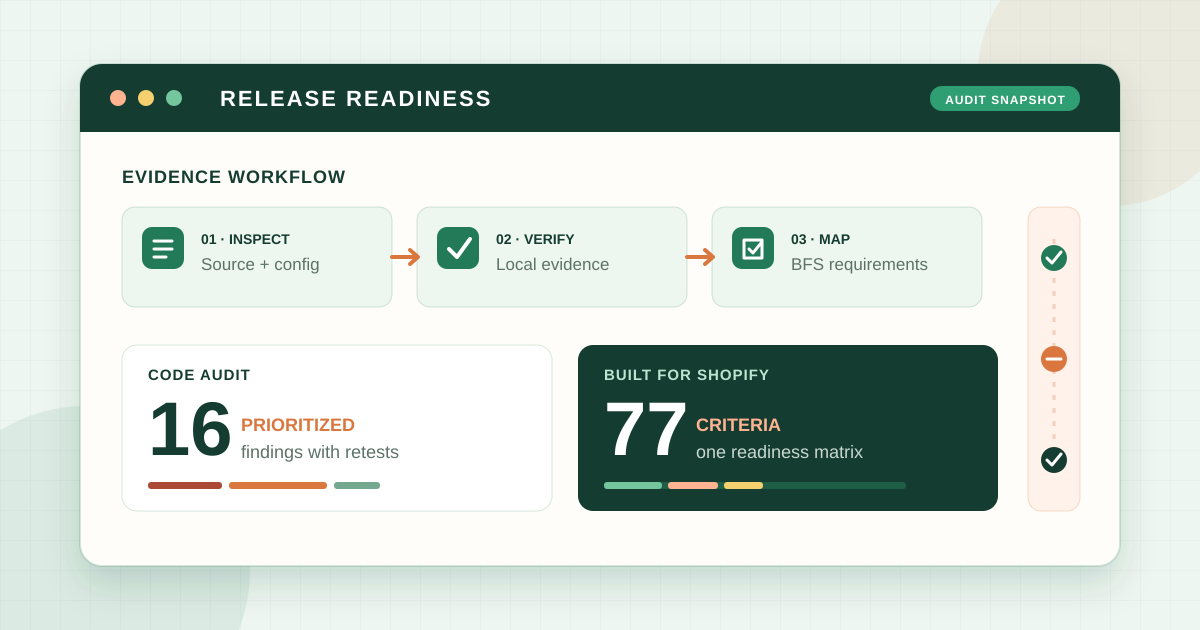
Sixteen findings were ranked by impact and paired with a fix, retest, and evidence trail.
Shopify app audit case study
A two-pass code and Built for Shopify readiness audit gave a mature app team a clear decision, prioritized remediation plan, and verification checklist.
The challenge
The team had a mature public Shopify app and wanted to understand whether the reviewed release was ready for Built for Shopify.
The answer had to separate source-level facts from dashboard evidence, rank engineering risk, and make the next decision clear without treating a local build as proof of production readiness.
The method
The review kept observed behavior, reproduced boundaries, and external verification needs distinct so every conclusion remained traceable.
Review architecture, security, privacy handling, Shopify integration, quality gates, and release configuration against one identified commit.
Exercise selected code boundaries with synthetic data and no Shopify, database, or production writes.
Record each requirement once as Pass, Fail, Verify, Not applicable, or Conditional fail, with the evidence needed to change that status.
The 77-item scorecard reflects the requirements snapshot used for this audit on 6 September 2026. Shopify’s current requirements remain authoritative.
Current BFS requirementsThe evidence
Technical severity prioritized engineering risk. The separate readiness matrix showed what passed, what failed, and what still required external evidence.
Code audit
Sixteen findings were ranked by impact and paired with a fix, retest, and evidence trail.
BFS snapshot · 77 criteria
What was delivered
Severity-ranked findings with evidence boundaries, remediation guidance, and targeted retests.
A complete readiness ledger that separated confirmed source findings from dashboard and live-store checks.
A reproducible record of the reviewed release, completed checks, limitations, and evidence still to collect.
A clear definition of what must be fixed and demonstrated before submitting the reviewed release.
The roadmap
Address the highest-impact engineering and data-handling risks, then prove the fixes with focused negative tests.
Resolve review-visible interface and workflow gaps and verify them in embedded desktop and mobile sessions.
Make quality gates deterministic, reconcile the deployed version, and collect the required Partner Dashboard evidence.
The outcome
The audit did not promise a badge or confuse source review with Shopify approval. It produced a defensible recommendation to postpone the application for the reviewed release.
Instead of an unstructured backlog, the team received an ordered path from immediate risk reduction to review preparation and final release evidence.
This case study covers the completed audit deliverable. It does not claim that remediation or Built for Shopify approval was completed.
Make the next release decision with evidence
I can audit one identified release, separate confirmed findings from external checks, and turn the result into a practical remediation plan.
Thanks — I’ll reply directly by email.